

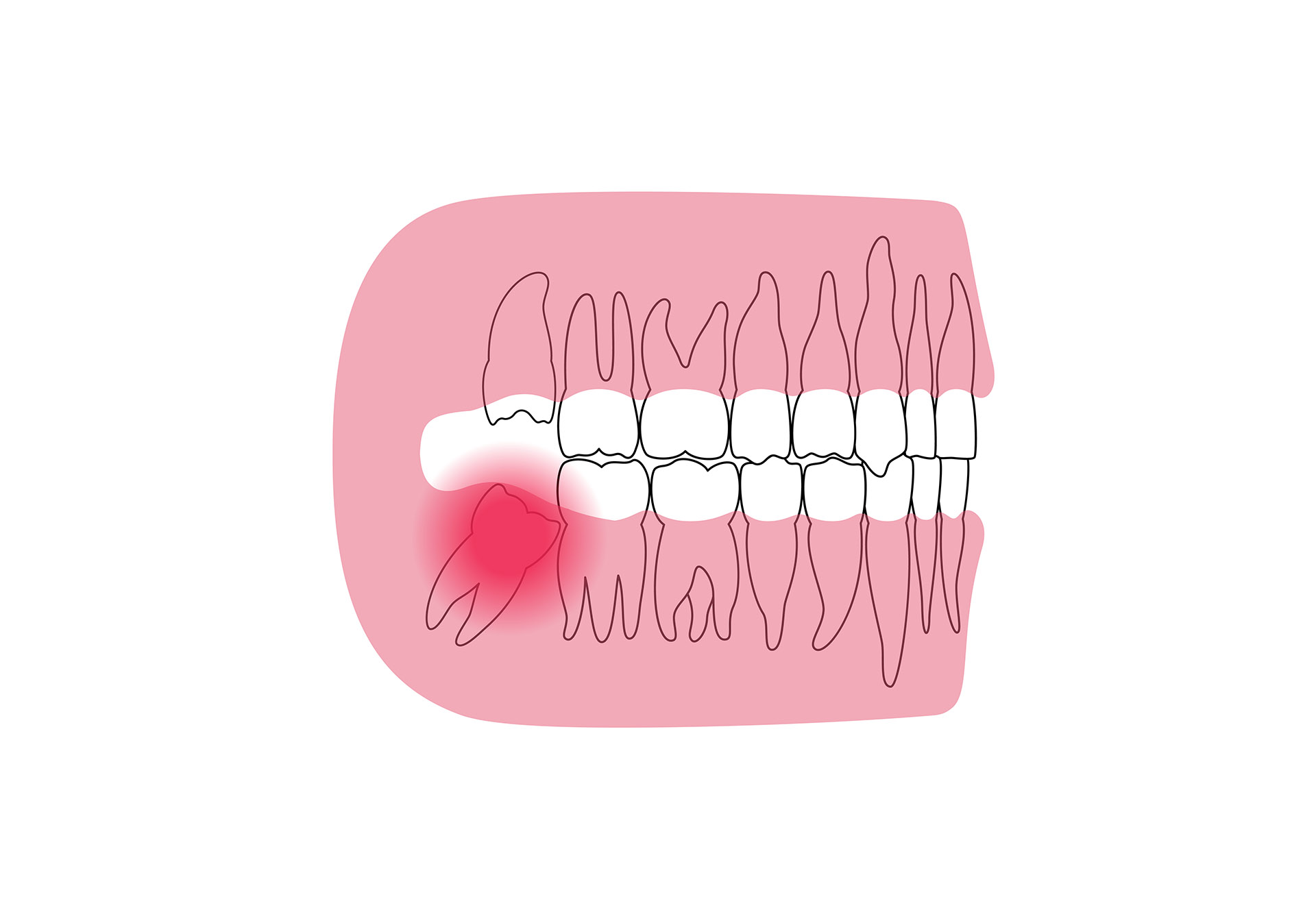
Impacted wisdom teeth occur when your third molars become partially or completely trapped in your gums or jawbone. This can lead to a range of oral health problems, including infection, tooth decay and gum disease. Surgical removal is often recommended as a treatment for impacted wisdom teeth.
Symptoms and causes Diagnosis and tests Management and treatment Prevention Outlook / Prognosis Living with
IMAGE OF A SEMI-CLOSED TEMPERATURE

overview
Wisdom teeth that do not erupt properly from the gums are referred to as impacted wisdom teeth.
A partially impacted wisdom tooth covered by gum tissue.
What are impacted wisdom teeth?
Wisdom teeth — also called third molars — are the last set of teeth to grow. They usually erupt (break through your gums) between the ages of 17 and 25. Sometimes, wisdom teeth erupt in line with your other teeth and don’t cause any problems. Other times, they get either partially or completely trapped in your gums or jawbone. This is referred to as confinement. Impacted wisdom teeth can cause a variety of oral health problems, including cavities, gum disease, and infections.
Total wisdom teeth, partial wisdom teeth and no wisdom teeth: What’s the difference?
Fully impacted wisdom teeth are not visible. They are completely hidden under your gums. A partially impacted wisdom tooth is slightly visible because part of it has erupted. Wisdom teeth that have not erupted have erupted and are completely visible above your gum line. It is important to note that uncapped wisdom teeth can still cause problems.
Soft tissue impaction versus hard tissue impaction
You may hear your dentist use the terms “soft tissue crowns” and “hard tissue crowns.” Soft tissue impaction means that your tooth has erupted from your jawbone, but hasn’t broken your gum. Hard tissue impaction means that your tooth is still completely covered by your gums and jawbone.
What are the different types of impacted wisdom teeth?
There are four types of wisdom teeth incarceration. Each type matches the position of your tooth:
Medial inclusion is the most common type. It occurs when your wisdom tooth is angled toward the front of your mouth.
Peripheral impaction, the rarest type, occurs when your wisdom tooth is angled towards the back of your mouth.
Vertical impaction is when your wisdom tooth is in the correct position for eruption but is still trapped under your gums.
Horizontal impaction is when your wisdom tooth is completely to the side, trapped under your gums. Horizontally impacted wisdom teeth are often painful because they put too much pressure on the teeth in front of them.
How common are impacted wisdom teeth?
Impacted wisdom teeth are extremely common. According to the American Academy of Oral and Maxillofacial Surgeons, 90% of people have at least one impacted wisdom tooth.
How do impacted wisdom teeth affect my oral health?
Impacted wisdom teeth can cause pain, infection and damage to other teeth. Wisdom teeth are also difficult to clean. As a result, they are more prone to tooth decay and gum disease.
Can impacted wisdom teeth cause headaches?
Yes. In some cases, impacted wisdom teeth can cause reflex pain in your jaw, face and head.
SYMPTOMS AND CAUSES
What are the symptoms of infected wisdom teeth?
Sometimes, impacted wisdom teeth do not cause any noticeable problems. Other times, symptoms may develop suddenly or gradually over time. Signs of impacted wisdom teeth include:
Pain or swelling of your jaw or face.
Red, swollen or bleeding gums.
A bad taste in your mouth.
Bad breath (halitosis).
Difficulty opening your mouth all the way.
What causes impacted wisdom teeth?
Wisdom teeth usually impact when your jaw doesn’t have enough space to accommodate your teeth. Sometimes, a tooth can erupt at the wrong angle, which can lead to an impaction.
DIAGNOSIS AND EXAMINATIONS
How do you know if your wisdom teeth are knocked out?
Your dentist will do an examination and ask you about your symptoms. They will also take dental x-rays to see if your teeth are impacted and if the jawbone or other teeth are damaged.
MANAGEMENT AND TREATMENT
How are impacted wisdom teeth treated?
If your affected teeth are causing pain, infection or other dental damage, it is usually recommended to have them removed. Many dentists recommend this oral surgery as a preventative measure to reduce the risk of future problems.
Are clenched teeth more painful to remove?
While impacted wisdom teeth are generally more difficult to remove, the procedure is not necessarily more painful. Your dentist will give you painkillers to manage any post-operative (after surgery) discomfort.
What are the risks and complications of wisdom tooth removal?
Like any surgery, wisdom teeth removal comes with some potential risks and complications, including:
Dry hive. This happens when the blood clot from surgery dislodges from your tooth socket prematurely (early), exposing your bone.
Contamination. Sometimes bacteria, food or debris (pieces of garbage) can get trapped in the tooth socket, resulting in infection. Your dentist may prescribe antibiotics to treat an oral infection.
Damage to adjacent anatomical molecules. Sometimes your nerves, jawbone, sinuses, or other teeth can be damaged during wisdom teeth removal. Advanced surgical techniques reduce the risk of these injuries, but they can still occur. Additional oral surgery may be needed to treat this type of damage.
How long does it take to recover from wisdom teeth removal?
Most people fully recover from wisdom tooth removal in one to two weeks. In most cases, you can return to work, school, and other normal activities in just a few days.
PREVENTION
Can I prevent wisdom tooth impaction?
Although you can’t prevent wisdom teeth, you can reduce your risk of the problems they cause. Practice good oral hygiene and consider having your wisdom teeth removed at an earlier age if they start to cause problems.
OUTLOOK / FORECAST
Is it necessary to remove affected wisdom teeth?
If your wisdom teeth are knocked out but not causing problems, you probably don’t need to have them removed. However, if you start to experience symptoms, removing them can reduce your risk of other problems and improve your overall oral health.
What happens if you don’t remove affected wisdom teeth?
If your impacted wisdom teeth are causing pain and other symptoms, leaving them in place can be bad for your oral health. Affected wisdom teeth are more prone to infection and abscesses — and can cause damage, decay and disease in healthy teeth.
When should I seek care for impacted wisdom teeth?
If you have pain or other symptoms affecting the area behind your last molar, schedule an appointment with your dentist. They can determine if your problems are due to impacted wisdom teeth.
Impacted wisdom teeth can cause a wide range of symptoms, including swelling, bad taste and pain that radiates throughout your jaw and face. Wisdom teeth removal is a common oral surgery procedure that can reduce your symptoms and reduce your risk of future oral health problems. Talk to your dentist about whether this treatment is right for you.